Friday, February 5, 2010

The Tico's Monkey


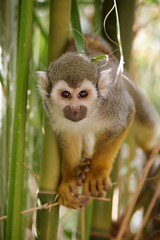
Squirrel Monkey looking at meImage by Daniel Greene via Flickr Quick Facts:

- Squirrel Monkeys live in the Tropical Forest in the Canopy

- Brain to Body mass is 1:17 which is the largest of all primates
humans have a ration of 1:35.

- They live in groups of up to 500.

If I had to pick a monkey that best represents to people of Costa Rica I would have to go with the Squirrel Monkey. First of all they happen to be the smallest monkey in Costa Rica. Most Ticos happen to be not extremely large although with the arrival of Wendy's and other fast food chains this could change. When on a family vacation or traveling with your students I suggest taking the extra effort to try and see these monkeys. One sure bet is that they will make their way to the park of Manuel Antonio at 4pm everyday jumping ridiculous lengths and free falling to and grabbing onto branches the size of an eyelash. Another reason why I like to call this the Tico's monkey is that it is the most passive monkeys. I feel this is quite fitting for a country that doesnt have an army and for a country that has a reputation of the people being very peaceful and kind. Probably the most interesting fact about this monkey is that is that it is endangered. There are an estimated 1500 monkeys left in Costa Rica and this is the only area where these monkeys can be found making it endemic to Costa Rica. So if you have the chance to pass by Manuel Antonio make sure you pass by and visit a species that might not be along too much longer. We can hope that it is and their are associations doing much to help and if you want more information you can visit www.ascomoti.org.
Enhanced by Zemanta

Thursday, February 4, 2010

The New Highway from San Jose to the Pacific


With over 34 years of waiting it seems that the famous Caldera highway is now open. If we do the math the highway stretches 77km and if it took 34 years that would make the average of almost every 2 km took a year. They followed all the proper standards for road construction with 1 guy working and 4 guys watching. It took 34 years for the first week to have people still complaining when it was open. The main complaints I have heard so far is that the extra emergency lane for ambulance and fire rescue is only usable if you plan on rescueing somebody in a vehicle no bigger than a Harely. Another complaint was that the steep cliffs that have been cut through the mountains had softball size rocks fall into the road becuase of heavy winds. This could make it very interesting for the rainy season and lets hope it does not turn into a nightmare of landslides like Cerro de La Muerte highway. All in all the highway is still much much nicer than the other option of getting to the coast. The highway measures 77km and literally cuts your time in half of driving to the Pacific Coast. The cost with all the tolls comes to a total of $3.47 which most people are happy to pay to get to the beach before sunset after a long day of work. There are still some people that are not that happy to pay. The local communities where this highway blasted through has some of the locals not too happy. They are asking for stop lights which might not happen but they are also upset that they have to pay the tolls of which a lot of them might have to travel to San Jose daily for work and spend 20% of their daily salary on tolls. With all of this said the highway will open up amazing opportunities for this country and it seems that mostly everyone thinks it was worth the 34 year wait.

Wednesday, February 3, 2010

Costa Rica ranked number 3 on the Planet


Institute of Geosciences of the Universidade F...Image via Wikipedia Just this last week the news came out that Costa Rica was ranked number three on the planet for protecting their land and environment awareness. The ranking was based on Environmental Performance Index (EPI). This is the third report of this biannual study that measures how a country is addressing pollution control and natural resource management challenges. The EPI is split up into 10 different categories of which each country is studied on which are: environmental health, air
quality, water resource management, biodiversity and habitat, forestry, fisheries, agriculture, and climate change. This was a study done by Yale University including over 160 countries. The two countries that were ahead of Costa Rica were Switzerland and Iceland. This is a great accomplishment for Costa Rica ranking third compared to the US ranking 61. The US was ranked very well for safe drinking water and forest preservation but really fell with emissions of gases. Costa Rica can be very proud of being so close to the top in a decade in when the country has gone through so much development. The new and up coming countries of China and India are ranked 121 and 123. This study was concluded at the end of 2009 and does not reflect any action that has gone into affect for 2010. Much of the study is based on the amount of money a country is willing to invest in the the environmental concerns of the nation. Not to say that money will fix everything but when money is managed correctly and invested into the environment of a nation it seems that their scores became higher. Chile invest a lot of money into their environment and was ranked a solid 16th while Argentina does close to nothing for the environment and was ranked 70th. One interesting fact in the Press Release of this study is that the countries known to have less corruption in the govt were also seen to have better scores on the EPI. So I leave you with saying dont be afraid to invest a little in your environment it makes for a great gift to anyone.
Enhanced by Zemanta

Wednesday, January 27, 2010

Costa Rica Families


With our company trying to work more and more in rural tourism we are realizing why all of our clients and most tourist for that matter leave not only falling inlove with the natural beauties of this country but also the people. We operate tours for families and students into rural areas of Costa Rica and we offer a true Costa Rican experience. The one interesting thing a lot of tourist notice is that you dont have to move out of the house when you turn 18 and that most immediate families still live very close to eachother. It is interesting to see a mother and her daughter taking care of grandma and grandpa and also the great grandkids. When you google nursing homes in Costa Rica you can come up with maybe one home and when you google it in the US you get close to 75,000 different homes. I believe the reason for this is because of the families staying together which is a beautiful thing and something that should be valued as part of the Costa Rican Culture.

Saturday, November 7, 2009

A Scientist in Costa Rica


While the whole world is flocking to the beauty and the biodiversity of Costa Rica, we cannot forget one of the first men to discover the magic of this Central American paradise, Alexander F. Skutch. Armed with his new doctorate in botany from Johns Hopkin University, Skutch left Baltimore in the late 1920s to study bananas in Panama.
As the story goes, Skutch sat in his office and watched a bird build a nest outside his window. This was the beginning of the botanist’s long love affair with birds. After a sojourn to South America, Skutch bought a farm in southern Costa Rica and married. He worked the farm and studied birds for thirty years. Living in isolation for periods of time, Skutch says that he was always safe and healthy. The only time he came close to danger was during the Costa Rican Civil War in 1948, when mercenaries roamed the countryside.
Since the Great Depression was raging in the USA, grant money to study birds was out of the question. After using his savings, Skutch found that by selling plants he could raise money to support his study of birds.
Skutch has catalogued the patterns of hundreds of species of birds in Costa Rica. What has made his studies different from others is that he has never killed a bird, except maybe a hawk in defense of smaller birds. All of Skutch’s specimens remained alive. He studied their patterns and habits, recording their histories. His farm became a haven for birds. Skutch has written many scientific and popular books on birds. In addition his records reveal much about mountains, rivers and the simple rural communities in which he has lived.
Today Skutch is a legend in Costa Rica. Those who have had the privilege of talking with him wear the distinction like a badge of honor. Sometimes a nature guide will mention meeting Skutch the way a kid will talk about meeting a soccer star. A quiet studious man Skutch has made a lasting mark on Costa Rica. His books are classics. He is referred to as the most famous scientist you never heard of.