Todays topic is the anteater. We have all heard of one but have you ever seen one? Do you know anything about them?
An anteater does enjoy eating ants but also spends a lot of it's time eating termites. They are found around the world in the tropics. There are four different types of anteaters (echidnas, pangolins, aardvark, and aardwolf). All of these anteaters are practically toothless probably because what they eat is so small. The anteaters have long sticky tongues which allow them to get the ants. The anteater has the largest tongue in relation to it's body size of any mammal on Earth. It's tongue can reach up to 2 ft long. It uses it's claws to dig into the ant hill and then sticks its tongue into the hill up to 150 times per minute. This fast rate of sticking it's tongue in and out makes it difficult for the ants to bite the tongue. Then with no teeth the anteater takes the ants that have stuck to the tongue and crushes them on the roof of his mouth and then swallows them.
Costa Rica has three different types of anteaters. The first is the Giant Anteater (Myrmecophaga tridactyla) which weighs up to 45lbs and is a terrestrial forest dweller. The second is Tamanduas (Tamandua mexicana) which are medium sized and scansorial (which means it is capable of climbing). The third and smallest species is the silky anteater (cyclopes didactylus) is always arboreal (in the trees) and is rarely seen.
There you have it those are the three different species of anteaters in Costa Rica. Now it is time to go out and see them in the wild. Join us on a Costa Rica adventure!
Showing posts with label costa rica tours. Show all posts
Showing posts with label costa rica tours. Show all posts
Monday, January 17, 2011
Anteaters
LET'S START PLANNING YOUR TRIP
Click Here or Call Today: 1-855-CRR-TOUR
Click Here or Call Today: 1-855-CRR-TOUR
Owner, Tom Ranieri ►
Biography: 10 year Raft & Canyoneering Guide in Costa Rica, Certified Naturalist Guide, Wilderness EMT, Over 200 Family Trips Planned & Guided in Costa Rica.


Monday, November 29, 2010
Basilisk, Jesus Christ Lizard
I was trying to think of a blog topic for today and I was thinking of the new national Stadium in Costa Rica which was an $88 million dollar project by the Chinese. I was driving by there yesterday and was informed that the Stadium seats 35,000 and only has 500 parking spots.
This morning I was thinking about that and told a friend that squeezing all those cars in there will be similar to the way Jesus Christ fed all those people with such little bread. That is when my topic for today came to me. The JESUS CHRIST LIZARD happens to be one of the most interesting animals in Central America and I have nothing about it in this blog so it is long overdue to write about "The Basilisk" (Jesus Christ Lizard). For gosh sakes the thing walks on water!!!
Probably the best name I've heard given to the Basilisk besides Jesus Christ Lizard is "miniature dinosaurs". When you look at them it really does look as if you are looking at a dinosaur. It is the male species that looks the most like the dinosaur with it's large crest on head and back tail. The lizard can reach almost 1 meter long which is just over 3ft. This is a species that enjoys being in warmer weather at lowlands. You will hardly ever see one above 1000m (3,000ft).
Now everyone knows that they are called the Jesus Christ Lizard because this is the species that can actually walk on water. The question is are they really holy lizards sent by Jesus Christ or is there some other reason for this. Depending who you talk to most will say there is some other reason and I think I will go with that also.
The secret of walking on water for these lizards is that they have very large hind feet with flaps of skin along each toe. This is different than webbed feet. Along with these flaps of skin they move very quickly. The smaller Basilisk (Juveniles) can walk up to 10 or 20 meters across water while the larger (Adult) Basilisk can still do it but look as if they are struggling a little more than the youngsters. Sort of like a bunch of 55 year olds playing pick up basketball.
There are four different types of Species of Basilisk. The oldest reported Basilisk can live up to 7 years.
 |
| "JESUS CHRIST! I'm walking on water!" |
Probably the best name I've heard given to the Basilisk besides Jesus Christ Lizard is "miniature dinosaurs". When you look at them it really does look as if you are looking at a dinosaur. It is the male species that looks the most like the dinosaur with it's large crest on head and back tail. The lizard can reach almost 1 meter long which is just over 3ft. This is a species that enjoys being in warmer weather at lowlands. You will hardly ever see one above 1000m (3,000ft).
How do they Walk on Water
Now everyone knows that they are called the Jesus Christ Lizard because this is the species that can actually walk on water. The question is are they really holy lizards sent by Jesus Christ or is there some other reason for this. Depending who you talk to most will say there is some other reason and I think I will go with that also.
The secret of walking on water for these lizards is that they have very large hind feet with flaps of skin along each toe. This is different than webbed feet. Along with these flaps of skin they move very quickly. The smaller Basilisk (Juveniles) can walk up to 10 or 20 meters across water while the larger (Adult) Basilisk can still do it but look as if they are struggling a little more than the youngsters. Sort of like a bunch of 55 year olds playing pick up basketball.
There are four different types of Species of Basilisk. The oldest reported Basilisk can live up to 7 years.
Interested in Learning How to Walk on Water?
or
Plan an Amazing Family Vacation to Costa Rica
www.crrtravel.com info@crrtravel.com
Toll Free: 1-855-CRR-TOUR
Information for this article was taken from: "Costa Rican Natural History" - Daniel H. Janzen
LET'S START PLANNING YOUR TRIP
Click Here or Call Today: 1-855-CRR-TOUR
Click Here or Call Today: 1-855-CRR-TOUR
Owner, Tom Ranieri ►
Biography: 10 year Raft & Canyoneering Guide in Costa Rica, Certified Naturalist Guide, Wilderness EMT, Over 200 Family Trips Planned & Guided in Costa Rica.
Saturday, November 27, 2010
High Season for Tourism
If it has not already started for many then it is just right around the corner. The long awaited high season of Tourism in Costa Rica is from December till August with a few low parts but all in all that is when the industry of tourism is really moving and shaking.
This high Season of 2011 is a high season that tour operators, hotel owners, and travel agencies have been more anxious for than all the high seasons in the past. The reason for this is that it is coming off a very hard 2 years of recessions, an earthquake, and swine-flu which all took their toll on the economy of tourism here in Costa Rica. What I have learned is that with all the struggling we have had in the tourism industry it is important that we find the positive in the struggles that we had with the recession and things of such. If we can not find the positive then we essentially struggled for no-reason.
It looks to be a great year of growth here in Costa Rica. There seem to be many more families coming for a family vacation as compared to the last 2 years. Who knows maybe there were even some lessons to be learned because tourism was growing at a very fast rate every year for the last 11 years. Maybe the drop that we experienced last year remind us that it's not always about growth, getting bigger, and working like crazy. It is about doing what we love to do and that is working among the natural beauties of Costa Rica and doing it at a first class level.
Costa Rica still receives less tourist than many other parts of the world. This is one of the best parts that you can still find personalized service here. We need to remember that the beauty of visiting Costa Rica is not only it's nature but the smiling faces in the people and if we get caught up trying to make things bigger and bigger we will not have time to smile and laugh with the most important part of tourism and that is, our visitors.
If you are interested in visiting Costa Rica or just want some advice send us an email or give us a call we would love to chat. To all in the tourism industry of Costa Rica the CRR Team wishes you a very safe and fun high season!
This high Season of 2011 is a high season that tour operators, hotel owners, and travel agencies have been more anxious for than all the high seasons in the past. The reason for this is that it is coming off a very hard 2 years of recessions, an earthquake, and swine-flu which all took their toll on the economy of tourism here in Costa Rica. What I have learned is that with all the struggling we have had in the tourism industry it is important that we find the positive in the struggles that we had with the recession and things of such. If we can not find the positive then we essentially struggled for no-reason.
Lessons to be Learned
It looks to be a great year of growth here in Costa Rica. There seem to be many more families coming for a family vacation as compared to the last 2 years. Who knows maybe there were even some lessons to be learned because tourism was growing at a very fast rate every year for the last 11 years. Maybe the drop that we experienced last year remind us that it's not always about growth, getting bigger, and working like crazy. It is about doing what we love to do and that is working among the natural beauties of Costa Rica and doing it at a first class level.
Costa Rica still receives less tourist than many other parts of the world. This is one of the best parts that you can still find personalized service here. We need to remember that the beauty of visiting Costa Rica is not only it's nature but the smiling faces in the people and if we get caught up trying to make things bigger and bigger we will not have time to smile and laugh with the most important part of tourism and that is, our visitors.
If you are interested in visiting Costa Rica or just want some advice send us an email or give us a call we would love to chat. To all in the tourism industry of Costa Rica the CRR Team wishes you a very safe and fun high season!
Costa Rican Resource
www.crrtravel.com info@crrtravel.com
Toll Free: 1-855-CRR-TOUR
LET'S START PLANNING YOUR TRIP
Click Here or Call Today: 1-855-CRR-TOUR
Click Here or Call Today: 1-855-CRR-TOUR
Owner, Tom Ranieri ►
Biography: 10 year Raft & Canyoneering Guide in Costa Rica, Certified Naturalist Guide, Wilderness EMT, Over 200 Family Trips Planned & Guided in Costa Rica.
Wednesday, November 17, 2010
How do Monkeys Not Fall?
 |
| I'd like to see you swing through the trees Mr Human |
When I was watching this I was not thinking of their prehensile tail which some monkeys have basically as a 5th hand. What I was thinking about is their ability to judge on the dime everytime the distance of each branch and jump.
What I found out in reading "A Neo-Tropical Companion" was that monkeys without the prehensile tail actually face a smaller lifetime reproductive success because of the risk of falling. I have never seen this but YES monkeys do miss calculate, fall from trees, and become part of the decompisition of the eco-system.
Monkey's 3D Vision
Then I found the answer that I think I was looking for: Monkeys have Stereoscopic Vision. This is basically 3-D vision which allows the monkeys to measure depth perfectly traveling at high speeds. This allows the monkey not only to be able to judge the exact distance they jump but also the exact size of the branch they plan to lend their life to as they grab on to it.
Costa Rica Family Vacation
Costa Rica has four different species of monkeys and if you want to see them all then join us on a family vacation!
Costa Rican Resource
Family Adventure Experts
www.crrtravel.com info@crrtravel.com
US: 352 694 3462 CR: +506 2266 1559
Toll Free: 1-855-CRR-TOUR
LET'S START PLANNING YOUR TRIP
Click Here or Call Today: 1-855-CRR-TOUR
Click Here or Call Today: 1-855-CRR-TOUR
Owner, Tom Ranieri ►
Biography: 10 year Raft & Canyoneering Guide in Costa Rica, Certified Naturalist Guide, Wilderness EMT, Over 200 Family Trips Planned & Guided in Costa Rica.
Tuesday, October 12, 2010
Bairds Tapir
 Image by Andy Tinkham via FlickrThis is one of Costa Rica's most popular animals. It happens to be a flagship species of Costa Rica. There are many interesting facts about the Bairds Tapir (Danta) so I wanted to make a list. This animal is called the Rhino of Central America. Hope you enjoy:
- Life Span is 30 Years
- 4 Species exist (Bairds Tapir in Central America)
- Found in Every Continent except Antarctic; evidence of Super Continent Gondwanaland
- Species unchanged for millions of years
- Each toe has it's own separate hoof
- Nose and Upper lip combined into a flexible snout like an elephants trunk
- Travels alone
- Uses flexible nose to explore a circle of ground 1 foot in diameter w/o having to move it's head
- They love the water and can use their snout as a snorkel
Related Videos by CRRTravel:
- Costa Rica Family Adventures
- Costa Rica's Arenal Volcano
- Rural Tourism Costa Rica
Costa Rican Resource
Plan Your Family Vacation
US: 352 694 3462 CR: +506 2266 1559

LET'S START PLANNING YOUR TRIP
Click Here or Call Today: 1-855-CRR-TOUR
Click Here or Call Today: 1-855-CRR-TOUR
Owner, Tom Ranieri ►
Biography: 10 year Raft & Canyoneering Guide in Costa Rica, Certified Naturalist Guide, Wilderness EMT, Over 200 Family Trips Planned & Guided in Costa Rica.
Sunday, October 10, 2010
Braulio Carrillo National Park Costa Rica
For almost 3 years I worked the Pacuare River Rafting one day trip leaving from San Jose at 6am and arriving back to San Jose at 6pm. It was a very long day but still I have to say everyday you got up looking forward to the tour. It's just one of Costa Rica's best adventures that never gets old.
 One of my favorite parts about this trip was after the long 3 hours of paddling was getting out of the raft and the peaceful drive back to San Jose. Most of the client were sleeping because they were tired from rafting also. They had to rest up for the rest of their Costa Rica Family Vacation and we had to rest up for the next day of rafting. The best part about the drive back was the 45 minutes we spend in the Braulio Carrillo National Park. I still remember hearing a man who had traveled all over the world visiting some of the worlds diverse and jungle filled places.
The park measures 47,583hectares and was created in 1978. It was named after the president who went through great lengths to join the Central Valley to the Atlantic Coast Braullio Carrillo. Probably the most recognized area of the park are the volcanic peaks Barva, Cacho Negro, & Zurqui which can be seen from the now paved highway or the Rio Sucio which is two different color rivers (which was actually a scene from Jurassic Park & the movie Congo). Just a drive through the park on a clear day you will be promised a view of some of the most lush tropical forest you will see anywhere on Earth. The forest here is estimated to have around 6,000 different species of plants.
If you have the chance during your Costa Rica Family Vacation to visit the Braulio Carrillo National Park or atleast make the drive through our suggestion would be to try and do it early in the morning when the mist is rising. If you contact us and you really want to get a taste for the park we can take you hiking but it will not be your average touristy destination.
If you are headed from the Atlatic Coast or Pacuare River to the Arenal Volcano you will not pass the Braulio Carrillo Park although it might be worth to take a short detour if it is a clear day.
Related Articles by CRRTravel:
Costa Rica Family Vacation Specialist
Costa Rican Resource
www.crrtravel.com info@crrtravel.com
CR: +506 2266 1559 US: 352 694 3462
One of my favorite parts about this trip was after the long 3 hours of paddling was getting out of the raft and the peaceful drive back to San Jose. Most of the client were sleeping because they were tired from rafting also. They had to rest up for the rest of their Costa Rica Family Vacation and we had to rest up for the next day of rafting. The best part about the drive back was the 45 minutes we spend in the Braulio Carrillo National Park. I still remember hearing a man who had traveled all over the world visiting some of the worlds diverse and jungle filled places. He made the comment that that the Braulio Carrillo always seemed to amaze him like none other. He said it was so unique in that it was so close to a major populated area as the San Jose Central Valley area. I did not think much at the time and then he went on to tell me how much of the park he would guess has never been set foot on by humans. Not thinking much of it at the time I began to do some research and realized that the Braulio Carrillo National Park is not friendly terrain. It is wet (4,500mm per year), very mountainous & rugged, and extremely tough to get around with many canyons, waterfalls, & rivers. There are a few hiking trails but the more you think about it the more that man probably was right in saying that there are many parts of it that man has never seen and it sits right next too a worlds major Capital City, San Jose (Sort of a major Capital City).
The park measures 47,583hectares and was created in 1978. It was named after the president who went through great lengths to join the Central Valley to the Atlantic Coast Braullio Carrillo. Probably the most recognized area of the park are the volcanic peaks Barva, Cacho Negro, & Zurqui which can be seen from the now paved highway or the Rio Sucio which is two different color rivers (which was actually a scene from Jurassic Park & the movie Congo). Just a drive through the park on a clear day you will be promised a view of some of the most lush tropical forest you will see anywhere on Earth. The forest here is estimated to have around 6,000 different species of plants.
If you have the chance during your Costa Rica Family Vacation to visit the Braulio Carrillo National Park or atleast make the drive through our suggestion would be to try and do it early in the morning when the mist is rising. If you contact us and you really want to get a taste for the park we can take you hiking but it will not be your average touristy destination.
If you are headed from the Atlatic Coast or Pacuare River to the Arenal Volcano you will not pass the Braulio Carrillo Park although it might be worth to take a short detour if it is a clear day.
Related Articles by CRRTravel:
Costa Rica Family Vacation Specialist
Costa Rican Resource
www.crrtravel.com info@crrtravel.com
CR: +506 2266 1559 US: 352 694 3462
LET'S START PLANNING YOUR TRIP
Click Here or Call Today: 1-855-CRR-TOUR
Click Here or Call Today: 1-855-CRR-TOUR
Owner, Tom Ranieri ►
Biography: 10 year Raft & Canyoneering Guide in Costa Rica, Certified Naturalist Guide, Wilderness EMT, Over 200 Family Trips Planned & Guided in Costa Rica.
Friday, October 8, 2010
Voted by CRR as the Best of Costa Rica: Agree?
LET'S START PLANNING YOUR TRIP
Click Here or Call Today: 1-855-CRR-TOUR
Click Here or Call Today: 1-855-CRR-TOUR
Owner, Tom Ranieri ►
Biography: 10 year Raft & Canyoneering Guide in Costa Rica, Certified Naturalist Guide, Wilderness EMT, Over 200 Family Trips Planned & Guided in Costa Rica.
Sunday, October 3, 2010
Canyoneering Costa Rica
 Canyoneering is an adventure that has become just as popluar in Costa Rica as the rafting and ziplining in the last couple of years. If you are not familiar with canyoneering it is a sport that is common in the state of Utah in the USA and many other states out west. Here in Costa Rica many often mistake this sport with rappeling. It turns out canyoneering does often involve some rappeling but in Costa Rica companies will often sell you a tour of canyoneering or rappeling and it is important to know the difference.
Canyoneering in the Tropics
The canyoneering involves more of what it says and that is a "canyon". You actually make your way down on your hands and feet sometimes even your knees and butt. There is always water involved in Costa Rica being in the tropics you are surrounded by rainforest and at the bottom of the canyon is where the water tends to be and that is where you start the adventure. Depending on which canyon you are in the hike can be very strenuous but there are a number of trips most in La Fortuna area near the Arenal Volcano that have become commercial canyons that companies have made it possible for family groups and young kids (10 years and up) to make the trip possible. You do want to be in good physical shape though for this adventure and you might want to leave grandma in the spa or the option for the birding trip.
Where to Canyon?
There are a few different canyons in the area and the most commercially run ones are in La Fortuna area and they happen to be very proffesionally run, safe, and amazing fun for the family. There are also some places in Turrialba with the company Explornatura. If you get the chance to visit Costa Rica on a family vacation and you are looking for a little adventure I suggest squeezing in this adventure I know you will not regret it.Related Articles by Costa Rican Resource
LET'S START PLANNING YOUR TRIP
Click Here or Call Today: 1-855-CRR-TOUR
Click Here or Call Today: 1-855-CRR-TOUR
Owner, Tom Ranieri ►
Biography: 10 year Raft & Canyoneering Guide in Costa Rica, Certified Naturalist Guide, Wilderness EMT, Over 200 Family Trips Planned & Guided in Costa Rica.
Thursday, July 22, 2010
Why 2011 is the Best time to Buy Real Estate in Costa Rica

I work mostly as a tour guide in Costa Rica and have been doing it for ten years. I have seen the country change quite a bit. Just two years ago I was watching young men my age become millionaires buying and flipping properties on the Pacific side of Costa Rica. There have been a few cases when clients from the tours have asked about real estate and have even returned to look for property in Costa Rica.
The area I know best when it comes to the central Pacific side is the area of Dominical. It happens to be my favorite, the most green, and where the mountain meets the sea. In July of 2010 I toured a couple around for a week looking at real estate working with some realtors and seeing a few peices I knew of. What we saw was very interesting.
There is a lot for sale some of which are sales of people that want out because of the USA economy crash last year. But with all these things for sale we are not seeing much things being sold. Which if you are looking for property in Costa Rica and really want the best deals then maybe the best deals are yet to come. If the economy does not fix itself in the next few months like some might have expected it to then there will be more people needing to get out, more things for sale, and lower prices.
If I had the capital to invest in some land in Costa Rica I would wait till 2011 and get in. I really feel there is so much land down here on the coast in the hands of foreigners that there will be many more that need out which will cause a huge supply and not much demand and leave a gap there for very low prices. There is also much land left in the central valley. Right now more and more coffee plantations in Costa Rica are being cut into because of the growing population. The central valley is becoming a popular area because some of the best hospitals in Costa Rica are located in the Central Valley.
Its funny how things work. Before it was the Costa Rican selling his piece of paradise to foreigners to get a few dollars that they would have never seen any other way. The Costa Rican new how to live humbley and some kept there humble lifestyles and others splurged on new trucks and fancy living (for a few months then it runs out). What we have now is American's that need out only because they might have never knew how to live humbly. This might be the only answer to the economic problems. What do you think the answer might be?
If you are interested in a very nice Costa Rica bed and breakfast option in the San Jose area you might want to check out CLICK HERE.
LET'S START PLANNING YOUR TRIP
Click Here or Call Today: 1-855-CRR-TOUR
Click Here or Call Today: 1-855-CRR-TOUR
Owner, Tom Ranieri ►
Biography: 10 year Raft & Canyoneering Guide in Costa Rica, Certified Naturalist Guide, Wilderness EMT, Over 200 Family Trips Planned & Guided in Costa Rica.
Monday, May 31, 2010
Mount Chirripo (Highest Elevation in Costa Rica)

The adventure to Mount Chirripo is a hike that will take you to the top of Costa Rica. You will have the chance to be at Costa Rica's tallest point which measures 12,330ft. You are located at 9 degrees from the equator which can make the weather rather interesting in Chirripo. At night it can drop below freezing and during the day it can be extremely hot so you must be prepared for it all and of course some rain.
The Paramos is the part of Costa Rica that is located at an elevation of more than 10,000ft. It is in this area where normal tree growth stops and all you see is stunted trees in and around the area. Most of the hike to the top will take you through Costa Rican cloudforest where you will see many different flor and fauna. You might also have the chance to see Costa Rica's most beautiful bird which is the famous quetzal.
On a clear day one of the most memorable moments of being in Chirripo is seeing both coast. You can see the Pacific and Caribbean Sea from the top. I can not say that if you are in Costa Rica for a week you should take this 3 day trip during your stay but if you have extended time in Costa Rica and you want to do a serious hike then climbing Chirripo should definately be on your list and can be a great experience for any student travel program to Costa Rica.
LET'S START PLANNING YOUR TRIP
Click Here or Call Today: 1-855-CRR-TOUR
Click Here or Call Today: 1-855-CRR-TOUR
Owner, Tom Ranieri ►
Biography: 10 year Raft & Canyoneering Guide in Costa Rica, Certified Naturalist Guide, Wilderness EMT, Over 200 Family Trips Planned & Guided in Costa Rica.
Friday, May 28, 2010
Adventure Gear
When dealing with family vacations and student trips to Costa Rica you have to be sure you are using only the best equipment and gear for your adventures. Costa Rica is a country that lends itself to some amazing adrenaline pumping activities such as rafting, ziplining, and rappeling. These are all adventures where your gear can not be bought at Wal-Mart. You need to find proffesional gear used by proffesionals. Here we are going to give you an introduction to some of the basic gear you will see during an adventure trip to Costa Rica.
First of all you have ropes. In a country that is only 50 miles wide and has a peak of 13,000ft you can imagine that many things are vertical in Costa Rica. In vertical situations ropes are your best form of transportation unless you have a helicopter which mine is in the shop.
There are many different types of rope some are called Dynamic which means it has a bungee feel to it which works well on belay lines. Other ropes are called Static lines which stay firm and dont give. These are good for rescue lines. Ropes come in different sizes, braids, and materials.
A second piece of equipment is a caribiner. This is probably the single most popular piece of equipment for any adventurer. A caribiner you will find from rafting, rappeling, zipling, or even hooking gear up during a hike. The caribiner is made up of different parts. Different caribiners are made of different shapes and materials. They are measured by how strong they are by what is called kilo-newtons which is marked as KN on the caribiner. For each KN the caribiner can hold 225lbs of pressure.
The next and happens to be my favorite piece of equipment is called webbing. This is my favorite because it is by far the lease expensive. Webbing is incredibly strong and used as an achor to hook ropes up to rocks or trees inorder to do your descend.
On rafting trips the guides often use webbing as flip lines. The flip line is used to flip the raft over.
Another piece of equipment that you might see or you might not see are called handled ascenders which are used to go up the rope. This is the easiest way to climb up the rope but these ascenders have little teeth in them and over time they can damage the rope. Keep in mind they are not used for a rescue which means only one person can use them at a time. This is also a very difficult excercise and should only be done with experience. As you can see in the picture its a face of struggle.
There are many many more pieces of equipment that you might see during your adventure to Costa Rica but if you are into the outdoors and on a student travel trip or a family vacation this is a good start at what you should expect to see.
First of all you have ropes. In a country that is only 50 miles wide and has a peak of 13,000ft you can imagine that many things are vertical in Costa Rica. In vertical situations ropes are your best form of transportation unless you have a helicopter which mine is in the shop.

There are many different types of rope some are called Dynamic which means it has a bungee feel to it which works well on belay lines. Other ropes are called Static lines which stay firm and dont give. These are good for rescue lines. Ropes come in different sizes, braids, and materials.
A second piece of equipment is a caribiner. This is probably the single most popular piece of equipment for any adventurer. A caribiner you will find from rafting, rappeling, zipling, or even hooking gear up during a hike. The caribiner is made up of different parts. Different caribiners are made of different shapes and materials.
 They are measured by how strong they are by what is called kilo-newtons which is marked as KN on the caribiner. For each KN the caribiner can hold 225lbs of pressure.
The next and happens to be my favorite piece of equipment is called webbing. This is my favorite because it is by far the lease expensive. Webbing is incredibly strong and used as an achor to hook ropes up to rocks or trees inorder to do your descend.

On rafting trips the guides often use webbing as flip lines. The flip line is used to flip the raft over.
Another piece of equipment that you might see or you might not see are called handled ascenders which are used to go up the rope. This is the easiest way to climb up the rope but these ascenders have little teeth in them and over time they can damage the rope. Keep in mind they are not used for a rescue which means only one person can use them at a time. This is also a very difficult excercise and should only be done with experience. As you can see in the picture its a face of struggle.
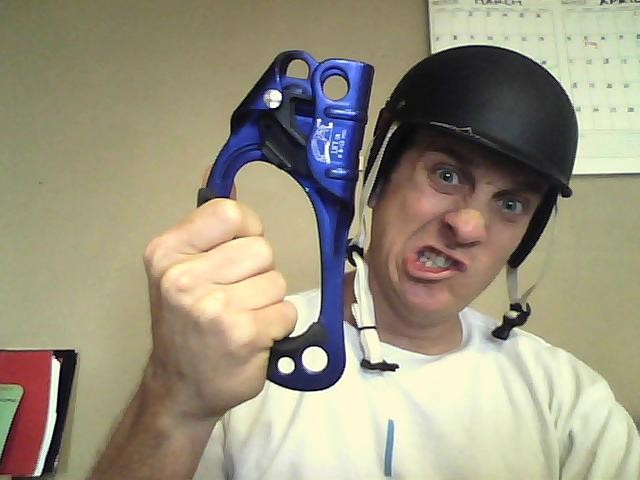
There are many many more pieces of equipment that you might see during your adventure to Costa Rica but if you are into the outdoors and on a student travel trip or a family vacation this is a good start at what you should expect to see.
LET'S START PLANNING YOUR TRIP
Click Here or Call Today: 1-855-CRR-TOUR
Click Here or Call Today: 1-855-CRR-TOUR
Owner, Tom Ranieri ►
Biography: 10 year Raft & Canyoneering Guide in Costa Rica, Certified Naturalist Guide, Wilderness EMT, Over 200 Family Trips Planned & Guided in Costa Rica.
Thursday, May 27, 2010
Educate Yourself on the Tropics

If you are coming to Costa Rica chances are you might have some interest in wildlife. If you dont then by the time you leave you should be interested in the wildlife of the tropics. With Costa Rica being one of the most bio-diverse places on the planet it is a perfect area to educate yourself with the different types of species of plants and animals of the tropics. Costa Rica can be used as an amazing classroom for student travel trips or for family trips that want to keep themselves and their kids educated. Every year the tropics are being discovered with more and more natural resources that can be used for so many different things. The idea behind our company is to protect these resources the best we can so that they can be used most effectively when the time is right.
Being educated on the tropics is an education that can go on forever and I can assure you there is not a textbook large enough to hold all the information of the tropics. What we have used as an excellent introduction to the plants and animals of Costa Rica is a book by John Kricher called "A Neotropical Companion". It would be a dream of mine that before every trip to Costa Rica be it a student travel trip or a family vacation that members of the group read this book. There is so much to see and do in Costa Rica and if you know whats in this book then you have atleast scratched the main surface and during your stay you will respect more the things you see and you will be able to relate to them. The way it always turns out is that kids or parents get interested in these things after they visit Costa Rica so they end up reading a book like this for their second trip to the tropics.
So for your next trip to the tropics if you want to feel like an expert when walking through the jungle read "A Neotropical Companion" by John Kricher and you will be well on your way to be a Nature Guide in the Tropics.
LET'S START PLANNING YOUR TRIP
Click Here or Call Today: 1-855-CRR-TOUR
Click Here or Call Today: 1-855-CRR-TOUR
Owner, Tom Ranieri ►
Biography: 10 year Raft & Canyoneering Guide in Costa Rica, Certified Naturalist Guide, Wilderness EMT, Over 200 Family Trips Planned & Guided in Costa Rica.
Wednesday, May 12, 2010
About Us

Costa Rican Resource is a company that has been operating Student Travel Tours and Family Vacations since 2002. This is a small company that concentrates on personalized attention. The company was formed by Tom Ranieri. He is from the State of Florida and has resided in Costa Rica for the last 9 years. Tom worked as a river guide on the Pacuare River where from there the company was formed. Tom's family moved down to Costa Rica to help with the business and now all operations are out of their office in San Jose de la Montana in Heredia located on the slopes of the Barva Volcano. With some excellent networking and the idea of the company being spread out through different small businesses Costa Rican Resource was formed.
This is a company that operates from many different levels. We have our own rafting department, video department, transportation department of which all are seperate owners and everyone gets a peice of the pie. Not only do seperate small business owners pay the bills with Costa Rican Resource but the amount of time, money, and work given back to communities is a major part of this company. The company makes donations but the idea of making the local communities, the orphanage, and families in rural areas being a working part of our company is the main idea. They offer our clients an amazing experience in which both benefit from the activities that take place.
Our company is always making progress forward in being the most environmentally friendly tour operator possible. During our tours you will notice the importance giving to the environment and the education each client will recieve on ways they can help.
We invite you to look at our site or even better contact some of our former clients and get an idea just how personalized, attention to detail, and proffesionally operated are the tours of Costa Rican Resource. PURA VIDA!!!
LET'S START PLANNING YOUR TRIP
Click Here or Call Today: 1-855-CRR-TOUR
Click Here or Call Today: 1-855-CRR-TOUR
Owner, Tom Ranieri ►
Biography: 10 year Raft & Canyoneering Guide in Costa Rica, Certified Naturalist Guide, Wilderness EMT, Over 200 Family Trips Planned & Guided in Costa Rica.
Saturday, May 8, 2010
A Man who works with a Passion

Just this last week I took the Swiftwater Rescue course in Pacuare. It was an amazing course with very experienced guides from all over Costa Rica. We camped out at the river for 3 nights and had 12 hour days in the river learning different Rescue techniques that we might need in the while rafting.
The teacher of the class is a man from California who has been in Costa Rica for 20 years. His name is Felipe Perez and he has done so much for the sport of rafting in Costa Rica. Felipe Perez is in my opinion what a role model should be. I know many Costa Ricans look to the millionaire football players and famous people but when I have kids I want them walking around saying "Like Felipe, if I could be like Felipe". The man absolutely loves what he does and he does it for the love of nature, the river, and the saftey of others. He has given this course over 200 times to guides all over the world. The advice Felipe gives are expert rescue techniques that all river guides should know. But probably the most important advice he gives is advice on life which is to listen to the river. He talks about all the things the river can teach you about life and probably the two most important is to enjoy the moment and live simply. Felipe is a perfect example of living these two rules excellently. He is always smiling and lives a very simple life always enjoying the moment.
From myself and all the river guides of Costa Rica I want to thank Felipe for making our jobs a proffesion and for being such a great educator to so many.
LET'S START PLANNING YOUR TRIP
Click Here or Call Today: 1-855-CRR-TOUR
Click Here or Call Today: 1-855-CRR-TOUR
Owner, Tom Ranieri ►
Biography: 10 year Raft & Canyoneering Guide in Costa Rica, Certified Naturalist Guide, Wilderness EMT, Over 200 Family Trips Planned & Guided in Costa Rica.
Friday, April 30, 2010
5 Things you must do in Costa Rica

5. Raft Pacuare River
4. Zipline
3. Eat an IceCream sandwich TRITS
2. Drink some Coffee
1. Keep a Journal
Family Vacation Planning Specialist
Costa Rican Resource
http://www.crrtravel.com/
info@crrtravel.com
LET'S START PLANNING YOUR TRIP
Click Here or Call Today: 1-855-CRR-TOUR
Click Here or Call Today: 1-855-CRR-TOUR
Owner, Tom Ranieri ►
Biography: 10 year Raft & Canyoneering Guide in Costa Rica, Certified Naturalist Guide, Wilderness EMT, Over 200 Family Trips Planned & Guided in Costa Rica.
Friday, April 9, 2010
Costa Rica Eco-Tourism

With tourism growing in Costa Rica and well over 1 million tourist arriving every year water bottles are usually the first request when getting off the plane. With the heat, sun, and adventures water is a must when traveling in Costa Rica. Lets just take 1 million tourist on 8 day adventures drinking two bottles of water per day. 8 days x 2 bottles = 16 bottles x 1 million tourist = 16 million plastic bottles (this is a low estimate but it should get the point across). With our company dealing with student travel in Costa Rica we really want to take advantage of the fact that we have the stage to teach. A rule on our student trips is that no plastic water bottles for the whole week. This means that each student gets their own bottle on the first day and we have larger containers of purified water that we refill each container. The bottles we use are oxo-biodegradable. The plastic container is completely degradable and has a useful life of approximately 36 months. If discarded, the product will become part of the environment leaving no methane, toxic residues or harmful fragments. Plastic wataer bottles are a big expense on oil. It takes 1.5 million barrels of oil annually to satisfy America's demand for bottle water. If this oil was converted to gasonline it could fuel 500,000 station wagons to take their families on a trip of the USA coast to coast. The USA's shortest point from coast to coast is 2,092 miles and Costa Rica is just 54 miles coast to coast. So just think about how many station wagons can go coast to coast in Costa Rica.
Family Vacation Specialist
Costa Rican Resource
http://www.crrtravel.com/
info@crrtravel.com
LET'S START PLANNING YOUR TRIP
Click Here or Call Today: 1-855-CRR-TOUR
Click Here or Call Today: 1-855-CRR-TOUR
Owner, Tom Ranieri ►
Biography: 10 year Raft & Canyoneering Guide in Costa Rica, Certified Naturalist Guide, Wilderness EMT, Over 200 Family Trips Planned & Guided in Costa Rica.
Monday, March 15, 2010
Manuel Antonio Trip with Hogar Siembra

This Saturday was one of the best tours Ive done. When there is time off in Costa Rica there is an endless list of things to do. Personally I enjoy doing the same stuff as when Im working. Over the years Costa Rican Resource has developed a relationship with a group of abandoned kids in Alajuela. Some of the kids are orphans, others have parents in jail, and others have been victims of child abuse. When walking into there home called "Hogar Siembra" you see 30 bunkbeds all in the same room and not exactly smiles everywhere. When you take them out for the day they transform into the young fun loving kids we all were. We have taken the group ziplining, rafting, and this weekend we went to Manuel Antonio which is Costa Rica's most visited National Park. Out of the 30 girls that went ages 12 - 17 none of them have ever been to Manuel Antonio. We had one of our best guides Jheudy with the day off who joined us in making it an educational experience from start to finish. I have taken tons of groups to Manuel Antonio and these girls were the first group to walk through the park with notebooks and pens. It turns out the girls will be donig presentations on their trip to the park but the point is that they were really into learning which made us feel great. It was a day full of fun from start to finish. We had breakfast, lunch, and plenty of icecream after playing in the hot sun of Costa Rica's most beautiful beach. On the way back in the bus we were singing songs on the radio and the radio DJ mentioned the name of the girls home and about their trip to Manuel Antonio. They all screamed like they just one Latin Idol. Although I continue to learn about the beautiful natural things of Costa Rica it is always a nice reminder that the most beautiful part about Costa Rica is its people. To the girls at Hogar Siembra, Que Dios les Cuide Siempre!!! The next trip we will be taking the girls canyoning near the Arenal Volcano.
LET'S START PLANNING YOUR TRIP
Click Here or Call Today: 1-855-CRR-TOUR
Click Here or Call Today: 1-855-CRR-TOUR
Owner, Tom Ranieri ►
Biography: 10 year Raft & Canyoneering Guide in Costa Rica, Certified Naturalist Guide, Wilderness EMT, Over 200 Family Trips Planned & Guided in Costa Rica.
Wednesday, March 10, 2010
5 Souvenirs you should take from Costa Rica

When traveling anywhere in the world it is not always about the trinket shopping for most things that are made in Taiwan or China. The real souvenirs are taken from real places and people you visit. When visiting Costa Rica I have come up with 10 things you should take with you on your trip home from Costa Rica:
5. Costa Rican Diet - The Costa Ricans eat healthy. There is not a lot of fats in the food it is high protein, carbs, and a lot of fresh fruits and vegetables.
4. Some Spanish - Go ahead and dont be afraid to try some Spanish. If you have to leave with just one phrase make sure its "PURA VIDA"
3. Memories - could not write these ten without the famous leave only "footprints" and take only "memories" when walking through the rainforest.
2. Local stop shopping - dont be afraid to go off the beaten path and stop at a local little mom and pops shop. The chances are the people will be very nice and you will have a long conversation of smiles, take some pics, support the local economy and be on your way.
1. Recycled Goods - if you want to have some souvenirs that are truly local then look in different shops and you will notice women groups from different villages who make wallets, purses, keychains, and things of such out of recycled goods such as coffee bags, egg cartons, milk boxes, ect. If you dont see these during your trip send us an email and we have the contacts to get you some goods.

LET'S START PLANNING YOUR TRIP
Click Here or Call Today: 1-855-CRR-TOUR
Click Here or Call Today: 1-855-CRR-TOUR
Owner, Tom Ranieri ►
Biography: 10 year Raft & Canyoneering Guide in Costa Rica, Certified Naturalist Guide, Wilderness EMT, Over 200 Family Trips Planned & Guided in Costa Rica.
Magma at Turrialba Volcano?
An article in La Nacion this morning informed us that they have been doing some interesting studies with the recent activity of the Turrialba volcano. The studies are conducted at night and it gives the the experts a look to see if any magma material is leaving that would be hard to see with the naked eye. They believe that there is a magma rock inside the volcano which could mean that we might see some lava soon. What they do not know is which way the lava would begin to flow. We will keep you posted on this very interesting activity.
The Turrialba volcano is almost identical to the Irazu volcano which is the tallest volcano in Costa Rica. In recent years tourist have made the trip to the top of the volcano but it is a very tough hike. The volcano has been relatively quiet for over 100 years and just this past year we have begun to see activity.
The Turrialba volcano is almost identical to the Irazu volcano which is the tallest volcano in Costa Rica. In recent years tourist have made the trip to the top of the volcano but it is a very tough hike. The volcano has been relatively quiet for over 100 years and just this past year we have begun to see activity.
LET'S START PLANNING YOUR TRIP
Click Here or Call Today: 1-855-CRR-TOUR
Click Here or Call Today: 1-855-CRR-TOUR
Owner, Tom Ranieri ►
Biography: 10 year Raft & Canyoneering Guide in Costa Rica, Certified Naturalist Guide, Wilderness EMT, Over 200 Family Trips Planned & Guided in Costa Rica.
Tuesday, March 9, 2010
A Tourism Specialist

Anne Ledezma has a number of years working in the Tourism Industry in Costa Rica designing family vacations and student travels. Tourism has boomed in the last decade in Costa Rica due to its natural beauties and inviting people. One of the reasons for success is the education and knowledge the people who work in tourism in Costa Rica bring to the industry. You will find many Costa Ricans who speak two, three, or even four languages. They are naturally very respectful people but they are educated in areas of how to profesionally treat tourist.
A perfect example in Anne Ledezma who has 15 years of making family vacations and student travel packets. Her experience comes from working with companies large and small. She is very well traveled in and around Costa Rica. Very often she invest hours in to clients just to send them off with advice even if no trip comes of it for the company she does it for the love of her country.
Using Anne as an example it is great to see the love most employees share for their country. Working in tourism is a blessing that most Costa Ricans take much pride in their natural beauties and taking advantage of this to show off just how "Pura Vida" the Costa Ricans are.
LET'S START PLANNING YOUR TRIP
Click Here or Call Today: 1-855-CRR-TOUR
Click Here or Call Today: 1-855-CRR-TOUR
Owner, Tom Ranieri ►
Biography: 10 year Raft & Canyoneering Guide in Costa Rica, Certified Naturalist Guide, Wilderness EMT, Over 200 Family Trips Planned & Guided in Costa Rica.
Subscribe to:
Posts (Atom)